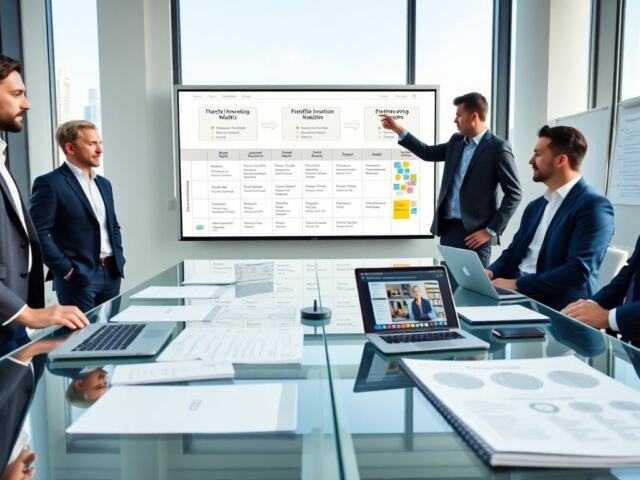
Leaders use digital transformation strategy frameworks to guide change. The article explains practical steps to choose and apply a framework in 2026. It shows criteria, common models, and a clear path to mix frameworks. The reader will learn how to match business goals to structure, people, and technology. The writing stays direct and actionable for managers and planners.
Key Takeaways
- Digital transformation strategy frameworks reduce risk and align teams by providing a unified language for goals, roles, and timelines.
- Effective frameworks cover business goals, capabilities, technology, skills, governance, and metrics with clear owners and timelines.
- The McKinsey 7S model helps align strategy, structure, and skills to ensure organizational readiness before technology investments.
- TOGAF structures enterprise architecture and enforces standards, helping avoid fragmented solutions and enabling phased work.
- Combining Gartner Pace-Layered and BCG Digital Acceleration frameworks allows prioritizing initiatives for stability and rapid innovation.
- Building a hybrid framework with phased roadmaps, pilots, and clear governance drives continuous learning and high-impact digital transformation outcomes.
Why Frameworks Matter For Successful Digital Transformation
Organizations adopt digital transformation strategy frameworks to reduce risk and align work. A framework gives teams a single language for goals, roles, and timelines. It shows leaders where to invest and what to measure. It helps link customer outcomes to technology and to skills. A clear framework speeds decision making and cuts duplicated effort. Without a framework, projects drift and leaders debate priorities. With a framework, teams track progress, identify gaps, and reallocate resources fast. The framework also helps external partners understand expectations and deliver consistent results.
Beyond alignment, frameworks provide practical guardrails: they define what “good enough” looks like at each phase, which capabilities must be in place before scaling, and how to sequence investments to reduce disruption. They also make it easier to onboard stakeholders by translating high‑level strategy into role-level responsibilities and short-term milestones. For large programs spanning multiple business units, a framework becomes the contract between product teams, IT, and operations—clarifying dependencies, handoffs, and escalation paths.
Core Components Every Effective Framework Should Cover
A solid digital transformation strategy frameworks model covers the same core parts. First, it defines business goals and customer outcomes. Second, it maps capabilities and processes that must change. Third, it lists required technology and data assets. Fourth, it identifies skills and organization design needs. Fifth, it defines governance, funding, and decision rules. Sixth, it sets metrics and learning cycles. Each part links to a clear owner and a timeline. Teams review these components every quarter and adjust scope based on results and resource shifts.
Practically, teams translate those components into artifacts: a capability map that shows gaps and owners; an architecture blueprint that highlights reuse and integration points; a skills matrix tied to hiring and training plans; and a governance charter that states escalation paths, funding gates, and KPIs. When assembling a framework, ask three questions for each component: what is the minimum viable outcome, who is accountable, and what is the acceptable risk level. These questions keep plans actionable and prevent frameworks from becoming theoretical checklists.
McKinsey 7S And Organizational Alignment: Design For Change
Leaders use the McKinsey 7S to align strategy with structure and skills. The model names seven areas: strategy, structure, systems, shared values, staff, skills, and style. Teams assess each area and score readiness. They fix gaps in structure or skills before heavy technology buys. The model forces leaders to address culture and leadership behavior. Change plans become more realistic when the 7S shows which areas need training or new roles. Many use the 7S alongside other frameworks to ensure that technology changes match organizational capacity.
To operationalize the 7S in a digital transformation program, create short assessments and remediation plans for the weakest S elements. For example, if systems (processes and tools) lag, plan incremental automation pilots with clear success criteria. If shared values or style (leadership behaviors) are weak, build targeted change interventions such as leadership coaching, visible sponsorship, and communication cadences. Use the 7S findings to sequence initiatives: address people and process blockers first, then introduce technology changes to accelerate outcomes rather than trying to force adoption later.
TOGAF And Enterprise Architecture: Structuring Technology And Data
TOGAF gives a method to design enterprise architecture and data flow. The framework breaks work into domains: business, data, application, and technology. Architects use the TOGAF ADM cycle to plan, design, and govern changes. The model enforces standards for integration, security, and data lineage. Teams document interfaces and reuse patterns to reduce technical debt. Using TOGAF helps teams avoid point solutions that complicate operating models. Project leaders map capabilities to architecture artifacts and use roadmaps to phase work in logical increments and to limit disruption.
In practice, TOGAF becomes the foundation for decisions about API strategy, integration platforms, and data governance. Architects create lightweight artifacts—data catalogs, interface contracts, and migration plans—that are reviewed at each governance gate. This reduces rework and clarifies upgrade windows for shared systems. When paired with agile delivery, TOGAF artifacts are kept intentionally minimal and evolved iteratively so architecture governance enables rather than blocks delivery. Explicit patterns for reuse and deprecation help teams retire legacy components on schedule.
Gartner Pace-Layered And BCG Digital Acceleration: Prioritizing Initiatives
Gartner Pace-Layered and BCG Digital Acceleration help teams sort initiatives by value and risk. Gartner divides applications into systems of record, differentiation, and innovation. Teams keep stability for core systems and move faster for innovation. BCG Digital Acceleration focuses on rapid experiments that scale when they show value. Combining these approaches helps teams prioritize funding and attention. Leaders plan sprints for innovation while protecting operations. The result is a balanced portfolio that delivers short-term wins and long-term modernization without overwhelming the organization.
Operational guidance: map each initiative to both a pace layer and an acceleration stage. For a system-of-record modernization, require higher standards for testing and rollback and schedule longer windows. For innovation experiments, set tight timeboxes, clear learning objectives, and predefined escalation criteria for scaling. Use a portfolio review cadence to rebalance funding monthly or quarterly based on outcomes from experiments. This hybrid prioritization reduces the tendency to over-invest in shiny pilots while the core estate deteriorates.
Implementing A Hybrid Framework: Roadmap Steps
Many teams build a hybrid from multiple digital transformation strategy frameworks. They start by assessing goals, current capabilities, and gaps. Next, they map which parts of each model best fit those gaps. Then, they create a phased roadmap with clear milestones and owners. Teams set short pilots to validate assumptions and to prove value. They align budgets to roadmap phases and assign a small steering group to unblock issues. The roadmap shows dependencies, dates, and success criteria. Teams review and adjust the roadmap after each pilot cycle.
A practical rollout sequence looks like this: (1) Discovery sprint to validate goals and constraints; (2) Capability mapping and architecture gating to identify risks; (3) Pilot design and a one- to three-sprint experiment with measurable outcomes; (4) Evaluation and decision gate to scale, iterate, or stop; (5) Incremental scaling with operational handover and upskilling. Keep the steering group small, with representation from product, IT, finance, and the business, and use clear decision rules (e.g., success thresholds and budget reallocation triggers) so progress is not stalled by governance overhead.
Implementing A Hybrid Framework: Metrics, Governance, And Continuous Learning
The hybrid approach needs simple metrics and tight governance. Teams pick a few outcome metrics: customer adoption, revenue impact, cycle time, and cost to operate. They also track leading indicators like feature usage and data quality. Governance sets decision gates for scaling pilots and for changing architecture. The steering group enforces funding rules and role clarity. Teams run short learning loops and publish lessons after each phase. Leaders use those lessons to update the hybrid model and to shift resources to the highest-impact initiatives.
To make metrics actionable, tie them to decisions: define what metric movement will trigger additional funding, pause, or decommissioning. Use dashboards that combine outcome KPIs and health indicators (technical debt, data quality, security posture) so leaders see trade-offs at a glance. Encourage a learning culture by documenting hypotheses, results, and next steps after each cycle; these artifacts feed back into the framework selection and help refine which parts of digital transformation strategy frameworks continue to add value versus which need replacement or simplification.